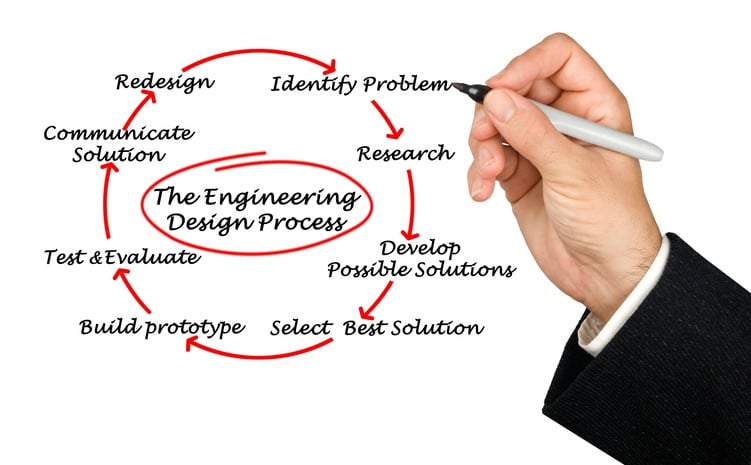
The engineering design process is a structured, iterative method for turning requirements into a validated, manufacturable product. It typically follows these core steps:
1. **Define the problem and requirements**
Clarify the application, performance targets, environmental conditions, regulatory needs, and constraints on cost, size, weight, and schedule. This becomes the basis for all design decisions.
2. **Concept development**
Generate multiple concepts and architectures that could meet the requirements. Compare options using engineering analysis, risk assessment, and manufacturability and serviceability considerations.
3. **Preliminary design**
Refine the selected concept into a more detailed design. This includes key component selection, electrical and mechanical layouts, interface definitions, and initial tolerance and thermal analysis.
4. **Detailed design and documentation**
Complete schematics, 3D models, harness layouts, bills of material, and production drawings. At this stage, design-for-manufacturability, design-for-assembly, and design-for-test are applied to ensure the product can be built reliably and repeatedly.
5. **Prototyping and testing**
Build prototypes and test them against defined requirements. Functional, environmental, electrical, and mechanical tests confirm that the design performs as intended and reveal issues that need correction.
6. **Design iteration and optimization**
Use test data and stakeholder feedback to refine the design. Address failures, improve reliability, simplify assembly, and reduce cost where possible while maintaining performance and compliance.
7. **Validation and design freeze**
Conduct final verification and validation to confirm that the design meets all technical, safety, and regulatory requirements. Once confirmed, the design is frozen for production.
8. **Production readiness and release**
Transfer the design to manufacturing with complete documentation, work instructions, quality checks, and test procedures. The result is a design that is ready for consistent, scalable production.
In summary, the engineering design process is a disciplined cycle of defining, designing, testing, and refining. When followed rigorously, it reduces risk, improves quality, and supports reliable, cost-effective manufacturing.